
How Automated Admissions Actually Decides: The Language Model Reads, Your Rules Decide
Every CIO asks the same question in the first five minutes: does the AI make the admissions decision? The only defensible answer separates the two jobs - the language model reads the documents, and your institution's own deterministic rules decide the outcome.
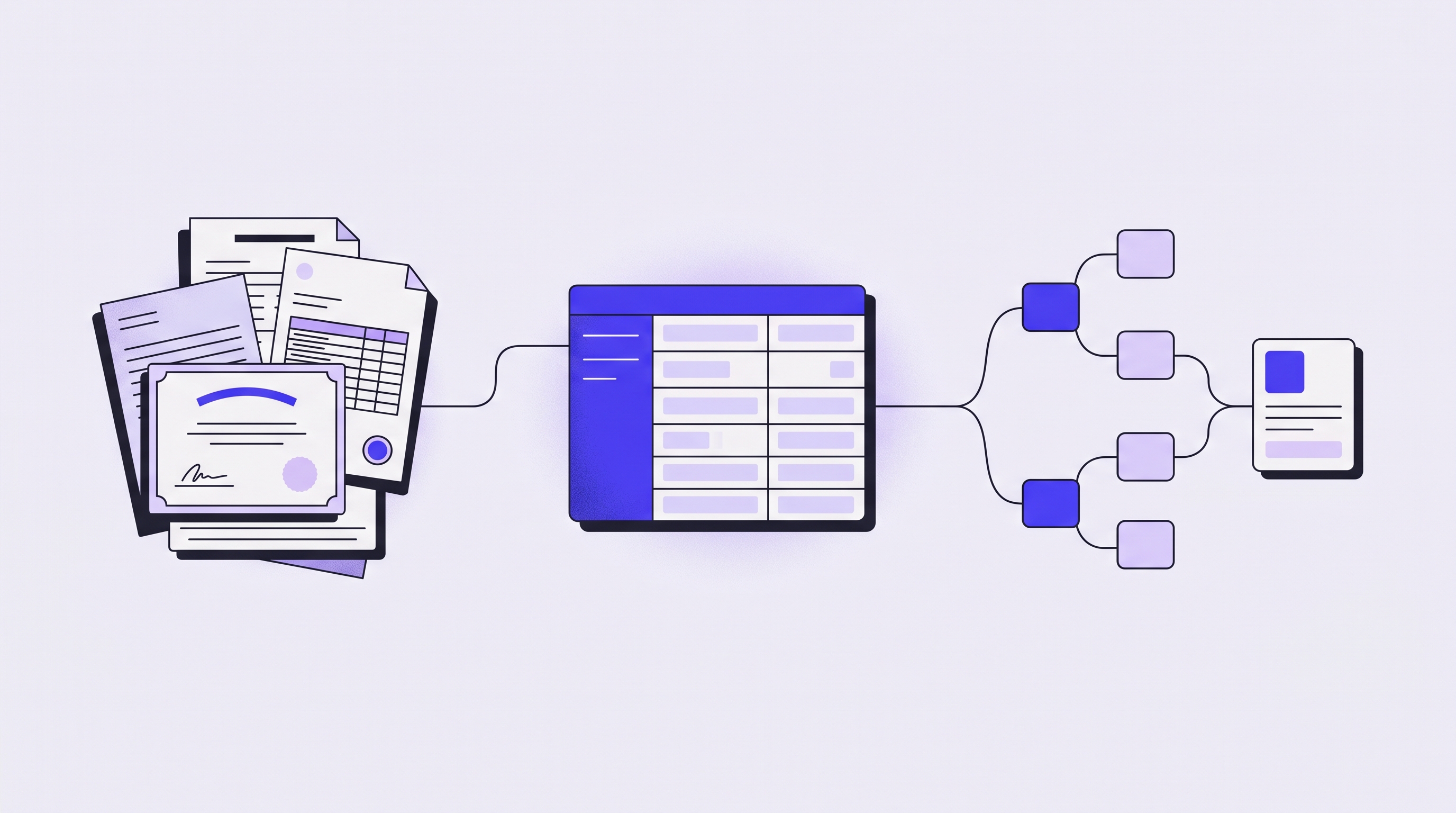
The question every CIO asks in the first five minutes of an admissions automation conversation is the same question. It does not matter which market, which institution, which procurement stage. The question is: does the AI make the decision?
The answer matters more than most vendors want to admit. Answered one way, it unlocks procurement. Answered the other way, it kills the deal before anyone has looked at the architecture. And there is a third version of the answer, the honest one, which is the only one that survives contact with a legal team, a registrar, or a regulator.
This piece walks through why that third answer is the only defensible one, and what an architecture looks like when it takes the question seriously.
Why AI making the decision fails the procurement test
Start with the technical reality. Large language models are probabilistic systems. They produce outputs that are statistically likely given their inputs, but they do not produce the same output every time, and they do not produce outputs that can be fully traced back to specific reasoning steps. This is not a bug that will be patched. It is a property of how the technology works.
For a lot of tasks this does not matter. If you ask a language model to summarise a meeting transcript, the fact that two different runs produce slightly different summaries is fine. The summary is a convenience, not a decision with legal weight.
Admissions decisions are not summaries. They are decisions with legal weight. They affect visa applications, student loan approvals, tuition commitments, and institutional compliance obligations. When a registrar, an auditor, or a regulator asks how a specific decision was reached, the answer has to be reproducible, auditable, and tied to documented policy. "The language model produced this output" is not a defensible answer. Neither is "we fine-tuned it on our rules," which is how a lot of vendors in this space are framing it.
This is not a scare story about AI. It is a straight reading of what admissions work requires and what language models are good at. The two lists overlap, but they are not the same list.
The split: reading versus deciding
The useful thing about noticing this is that it tells you how to design the system.
Language models are very good at reading. They can read a Vietnamese transcript, an Indian mark sheet, a Nigerian WAEC certificate, a Chinese gaokao result, or a scanned letter from a regional university that nobody has seen before, and pull out what is actually written there. This is a job that used to take an experienced assessor forty minutes per applicant. A well-tuned language model can do the reading in under a minute.
Deterministic logic is very good at deciding. Given a set of data extracted from an application and a set of rules written by your admissions team, a logic tree can evaluate every rule, produce a recommendation, and show exactly which rules fired and which did not. The decision is reproducible. Same inputs produce the same outputs. Every time, without exception. There is no probabilistic step, because there does not need to be one.
A responsible architecture does not try to make one component do both jobs. It separates reading from deciding, and it lets each component do the thing it is actually good at.
What reading looks like in practice
We covered the extraction step in detail in the companion piece on how AutoEnrol works. To summarise: the language model reads the uploaded documents, pulls the data into a structured schema (name, date of birth, qualifications, grades, English scores, document types), and flags anything it cannot read confidently.
Two numbers are worth knowing. Extraction accuracy on our benchmark of 800 labelled applications sits at 99.7%. The remaining 0.3% is almost always poor-quality source material: photographs taken at an angle, low-resolution scans, over-photocopied documents. When the pipeline hits one of these, it does not guess. It flags the field for human review. The 0.3% is the system knowing when it needs a person, not silent failure.
That is the entire role of the language model. Read the documents. Produce structured data. Flag what it cannot read. Stop there.
What deciding looks like in practice
This is where the weight of the architecture sits, and it is the part most vendors in this space are getting wrong.
Once the data is extracted, it is evaluated against your rules. Not rules we wrote. Not rules a model inferred. Rules your admissions team wrote, approved, and own.
The rules are stored as a logic tree. In plain English the tree looks like a long series of "if this, then that" statements: if the applicant is from a country on NOOSR Section 1, and the institution is in the recognised list, and the GPA meets the programme threshold, and the English score meets the programme threshold, then recommend an unconditional offer. Every rule maps to a specific line in your admissions policy. Every rule is versioned. When a rule changes, the change is logged, with a timestamp and the name of the person who approved it.
Getting your rules into the system is itself a piece of work. Most admissions teams have their rules scattered across handbooks, country guides, spreadsheets, and the heads of senior staff. Onboarding involves bringing all of that into one place. AutoEnrol's Onboarding Agent drafts rule translations from your handbook. Your admissions team approves, edits, or rejects. The approved rules make the decision.
The evaluation itself is deterministic. The same application, run through the same rules, produces the same recommendation every time. There is no fine-tuning, no temperature setting, no model drift. The logic tree is code, and code behaves the same way on Tuesday morning as it did on Monday afternoon.
This is what "your rules decide" means in practice. The institution's policy is what determines the outcome. The technology executes the policy faithfully. When a senior assessor disagrees with how a rule is reading in plain English, they edit the rule directly. Nothing goes live without your sign-off. If your policy changes next intake, you update the rule and the change is live.